As the first dedicated researcher for Bitbucket, I ran three parallel research programs — evaluating live AI features, mapping developer Jobs to Be Done across the full SDLC, and defining the competitive strategy that would make Pipelines worth switching to.
Bitbucket had never had a dedicated researcher. When AI became a strategic priority for Atlassian in 2025, the Bitbucket team was moving fast — shipping RovoChat into Open Beta, developing "Suggest fix" for Pipelines, and exploring inline code search — but doing it without a clear picture of what developers actually needed from AI, or how Bitbucket compared to GitHub and GitLab in their minds.
I was brought in as the first researcher for Bitbucket to answer three interconnected questions: Are the AI features we've already shipped working? What AI jobs should we solve next? And what would make Pipelines worth switching to?
These weren't sequential questions — they had to run in parallel, across two separate research programs, with a lean team and a product that was already in motion.
I structured the work into three distinct but interconnected programs — each answering a different question, all feeding into Bitbucket's AI strategy.
I conducted 6 × 60-minute interviews with software developers across SMB and enterprise companies — all active Bitbucket users, some also using Pipelines. Participants came from highly varied contexts: an AI startup in the UK, a medical device security team, a financial services firm with strict AI governance, and a government contractor with no AI access at all.
We tested three solutions in each session, tracking usefulness ratings and capturing both expected and unexpected use cases.
Prompts 1 and 2 — "Explain the code changes to me" and "Summarise the comments on this pull request" — were received positively by most participants. They saw clear, immediate value for understanding unfamiliar code and catching up on review threads.
Prompt 3 — "Summarise this pull request" — caused widespread confusion. Participants couldn't distinguish it from Prompt 1, and found the overlap frustrating. A consistent theme emerged: developers wanted AI to go deeper into the codebase, not just describe what's already visible.
"It's confusing because I already have a prompt to explain the code changes. Then I have another one to summarise the comments. Then I'm seeing another one that says summarise this pull request. It feels repetitive to me."
— P1, Backend Engineer at an AI startup
When asked what else they'd want to type into RovoChat, participants consistently expected code-specific queries — security checks, optimization suggestions, reviewing test coverage against Jira, and identifying suitable reviewers based on recent contributions. These weren't edge cases; they were the primary use case participants arrived with.
Most participants found "Suggest fix" immediately valuable — the concept of having AI diagnose a build failure and propose a solution was exactly what they wanted. The interaction pattern of opening a chat window from a button was expected and preferred, as it preserved visual context of the failure.
The main friction was around transparency and optionality. Participants wanted to know why the suggested fix was the right one, what alternatives existed, and — in several cases — they wanted AI to just go ahead and implement the fix after approval.
"Is there any way where there is a button where I can click and that code change will be committed back to my repo? Because you pretty much gave me everything. If you can even do that, then it's going to save time for me."
— P5, Principal Engineer at a financial services firm
Inline code search was the most universally well-received of the three solutions. Participants immediately understood its value and began generating their own use cases unprompted — security checks, performance optimisation, understanding legacy code, identifying where a function is used across the codebase.
The interaction of highlighting code and opening a contextual chat felt natural and direct. Unlike RovoChat's open-ended prompt interface, inline search gave participants a clear starting point — the code itself — which eliminated the uncertainty of not knowing what to ask.
Alongside the feature evaluation, I began building Bitbucket's first AI Jobs to Be Done framework — mapping developer goals across the full Software Development Lifecycle (SDLC). This gave the product team a structured way to prioritise AI investment: not just fixing what's broken, but identifying which developer needs have no AI solution yet.
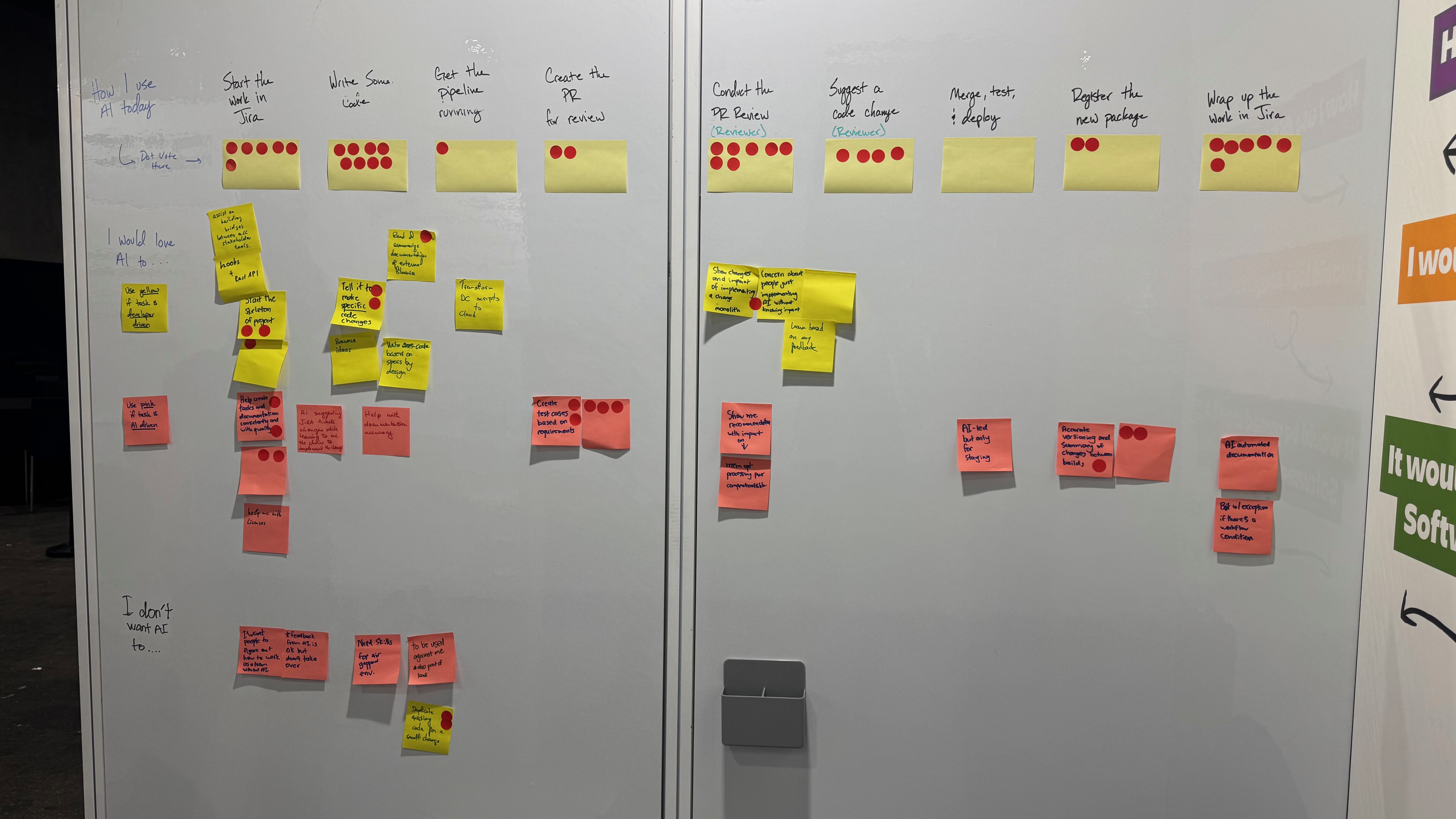
I showed participants a simplified SDLC workflow and asked two questions: where do you currently use AI, and where would you want AI but don't have it yet? This generated two layers of jobs.
In October 2025, I represented the Atlassian research team at TEAM 2025 in Barcelona — Atlassian's annual customer conference. I used the conference as a live research opportunity: testing the jobs I had already developed with a wider audience of Atlassian customers and developers, and capturing new ones to expand the framework. The in-person setting was particularly valuable for reaching enterprise customers and teams from regulated industries who don't typically appear in standard recruiting pools.
The Pipelines competitive research started from a deliberately honest question: Bitbucket vs. the Status Quo — how do we make Pipelines worth the migration? Not "how do we market Pipelines better" — but what would actually need to be true about the product, the pricing, and the architecture for a team to move away from what they already have.
I ran semi-structured interviews aided by a Kano-style questionnaire with DevOps engineers and engineering leaders across five different starting points: teams using GitHub Actions, teams using GitLab CI/CD, teams using Jenkins, teams using Azure Pipelines, and teams currently not implementing CI/CD at all. All participants used Jira and Confluence — so they were already Atlassian customers. The question was whether Pipelines could enter the conversation.
Deliberately diverse in terms of industry and regulatory context — because switching costs and risk tolerance look very different in cybersecurity versus healthcare versus financial services.
Today, Pipelines is only available as part of Bitbucket — we called this Model 0. I tested two alternatives using Kano-style questions to understand how participants valued each option.
The research identified five distinct barriers, split between upfront costs (one-time) and ongoing pressures. Understanding the type of barrier matters — because upfront barriers can be addressed by architecture and ease of migration, while ongoing barriers require features and pricing to continuously justify the switch.
"The only thing that would get us off that would be security issues. So for Pipelines to even be considered, it would have to be compatible with our SCM solution — which is not Bitbucket."
— P5, Sr. DevOps Engineer at a financial services company
"If you have a tool which is compatible with what you're doing, you're cutting off that learning curve for the person who is going to be operating it. You don't have to make full adjustments or rewrite everything."
— P5
There was no prior research to build on. Every insight I gathered became the foundation — for the JTBD framework, for the AI strategy, for how future researchers on the team would orient themselves to Bitbucket's users.
Every participant valued Bitbucket's integration with Jira and Confluence. But no product in the Atlassian suite was using AI to connect those integrations. That gap — obvious in retrospect — only became visible through research.
The most desired AI experiences didn't involve prompts at all — they required AI that observed context and acted without being asked. That's not a UX tweak; it's a fundamental architectural shift. Research surfaced that challenge early enough to shape the roadmap.
Usability research tells you how well your product works. Competitive research tells you why someone would choose you at all. Running both in parallel — not sequentially — gave the team a complete picture: is the product ready, and is the positioning right?